
Blended World Agents
Abstract
Most Large Reasoning Models (LRMs)–a class of AI systems designed to enhance logical reasoning, multi-step inference, and structured problem-solving–“reason” by unrolling free-form chains of thought (CoT). While effective in small problems, CoT text is unstructured, costly to generate, and notoriously hard to verify or reuse. This paper proposes a new conceptual framework called Blended World Agents (BWA), in which reasoning proceeds by traversing an explicit Conceptual-Blending (CB) ontology rather than emitting raw tokens. BWA combines (i) Fauconnier–style mental space templates and blend rules; (ii) a model-based reinforcement-learning formulation whose state is a partially filled blend and whose actions are slot-fills and blend-fires; (iii) a latent world model (encoder, transition, reward heads) that compresses blends for planning; and (iv) a lightweight interface that lets any static (pre-trained) Large Language Model (LLM) query and update that latent space. I argue that even a seed ontology of a few dozen templates in theory could outperform CoT on interpretability and token efficiency once implemented and validated. More importantly, the same static LLM can grow ΘCB by harvesting candidate spaces from raw text, proposing new blend rules, and letting a latent planner keep only high-reward additions. Once this self-expansion loop crosses a modest coverage threshold, BWA could potentially improve its ontology faster and more reliably than RL-on-CoT baselines, yielding a virtuous cycle of deeper plans, denser feedback, and accelerating knowledge growth. To ground the proposal, I sketch algorithmic designs, outline a hypothetical ablation plan, and walk through a worked micro-domain (first-time home purchase). Implementation and benchmarking are left to future work; this paper provides the architectural blueprint.
Download / bookmark via DOI: 10.5281/zenodo.15675193
Podcast episode (MP3): Blended_World_Agents_podcast.mp3
Visual presentation: Jump to video on this page · Open on YouTube
Key idea at a glance
Reasoning proceeds over a conceptual-blending ontology rather than free-text CoT, with a latent world model for planning.
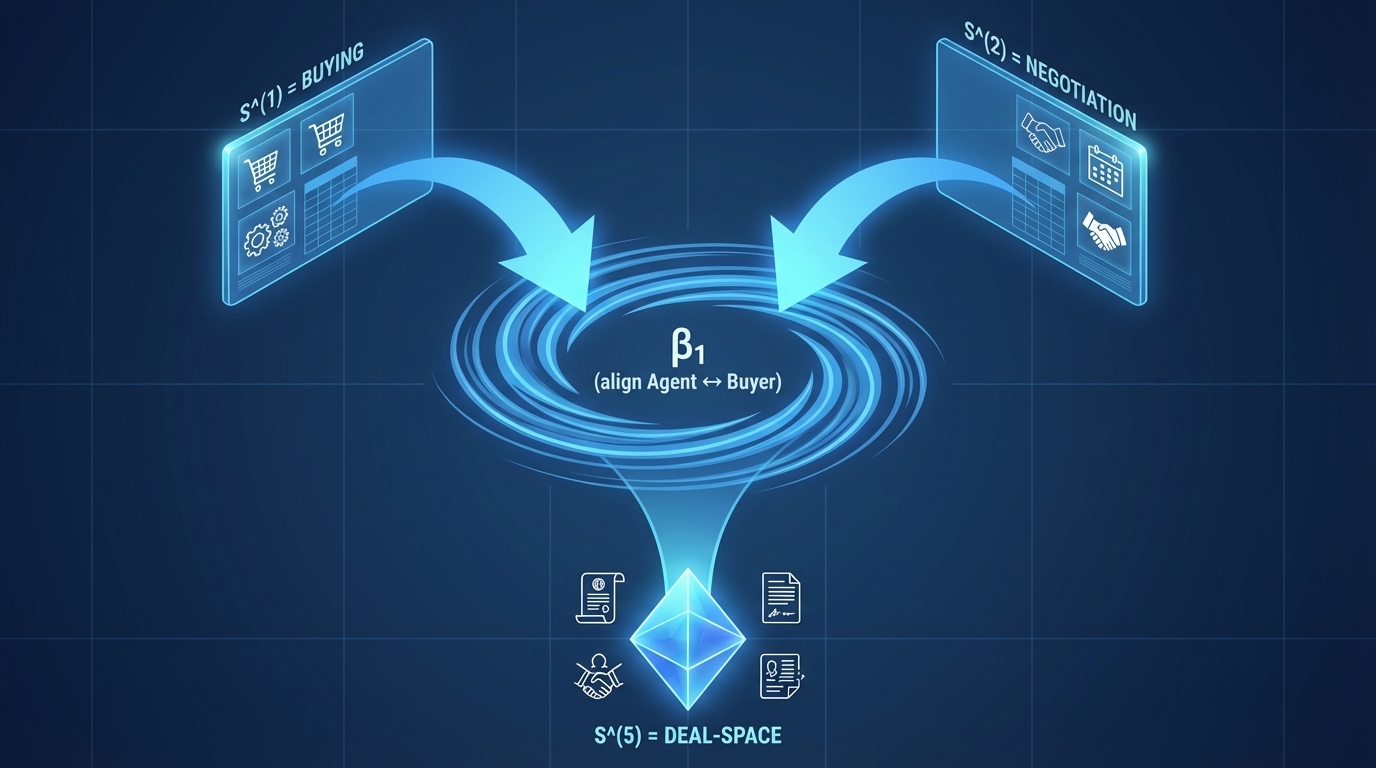
Conceptual-blending sketch inspired by the paper’s Figure 1.
Technical Blueprint
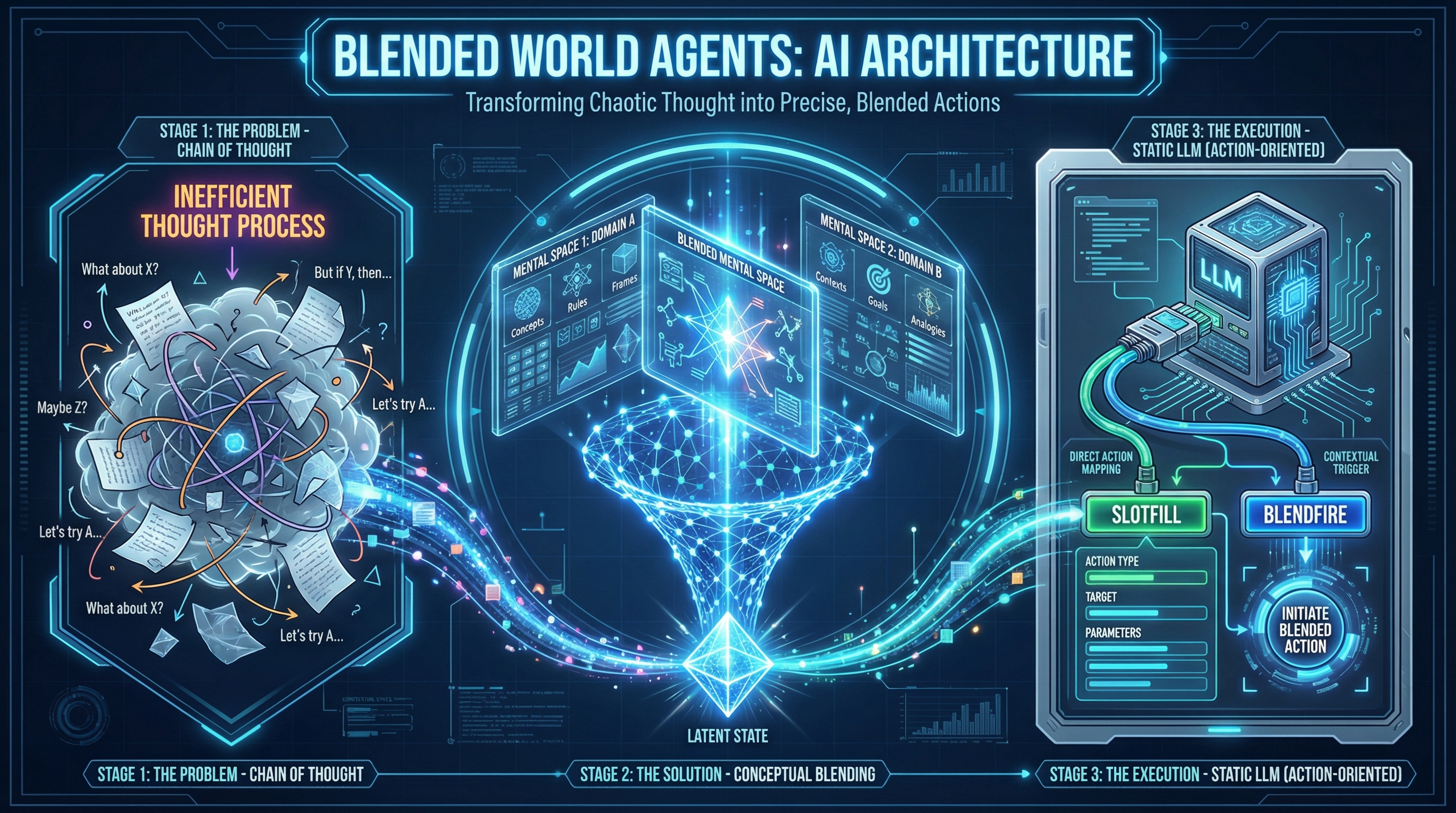
Technical Blueprint: The Blended World Agents (BWA) architecture transforms the chaotic, unstructured nature of standard 'Chain-of-Thought' (left) into a rigorous Conceptual Blending Ontology. By distilling reasoning into explicit 'Mental Spaces' and compressing them into a planning-compatible Latent State (z), the system enables a Static LLM (right) to bypass expensive text generation. Instead, the model interacts directly via precise symbolic actions like SlotFill and BlendFire, turning the "black box" of AI reasoning into an inspectable, verifiable, and token-efficient crystalline structure.
Podcast episode
An audio walkthrough of the core ideas and motivation behind Blended World Agents (BWA).
Tip: Most browsers support playback speed controls directly in the audio UI.
Visual presentation
A visual walkthrough of the idea with diagrams and concrete examples. If you prefer, you can open it on YouTube.
Cite
Johnson, E. D. (2025). Blended World Agents: A Conceptual-Blending World Model Approach to Reinforcement-Driven Reasoning Beyond Chain-of-Thought. Zenodo. https://doi.org/10.5281/zenodo.15675193
@misc{johnson2025bwa,
  title        = {Blended World Agents: A Conceptual-Blending World Model Approach to Reinforcement-Driven Reasoning Beyond Chain-of-Thought},
  author       = {Johnson, Erik David},
  year         = 2025,
  month        = jun,
  howpublished = {Zenodo},
  doi          = {10.5281/zenodo.15675193}
}